The 6 Points of ID, Decoded: What to Bring to Your NJ MVC Appointment
You booked the appointment weeks ago. You took the day off work. You drove all the way to your local NJMVC. And then they send you home. Because of paperwork.
This happens every day in New Jersey because of missing or misinterpretting the 6 points of ID. Not because the rule is hard. Because the website makes it look hard.
Here is the simple version. Read it once. Bring the right papers. Walk in ready.
The 3 Things You Need to Prove
To get a New Jersey driver license, permit, or ID card, you must prove three things at the counter:
Who you are. Your name and age. This is the "6 Points of ID."
Where you live. Your New Jersey address.
Your Social Security number. Or an ITIN. Or sign an affidavit if you don't have one.
You also fill out a form called the BA-208. You can print it from before you go. Or get one at the counter.
That's the whole job. Now let's break it down.
Step 1: Get to 6 Points With Your ID Documents
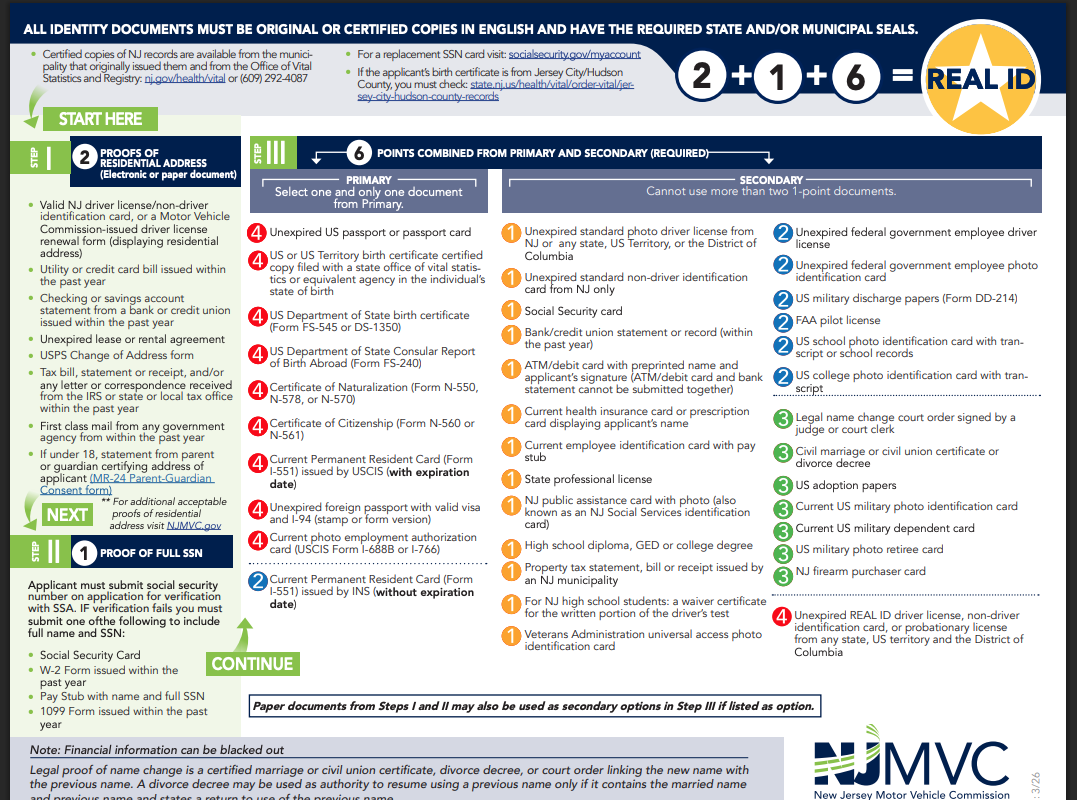
The NJMVC gives every paper a point value. You need at least 6 points total.
You pick one Primary document. Then you add Secondary documents until you reach 6.
The rules:
Use one Primary document.
Use at least one Secondary document.
Do not use more than two 1-point papers.
All papers must be originals or certified copies. No photocopies. No phone pictures.
All papers must be in English. Or come with a certified translation.
Primary Documents (Pick ONE - worth 4 points)
U.S. passport or passport card (not expired)
U.S. birth certificate (certified copy with the state seal — not the hospital one)
Certificate of Naturalization (Form N-550, N-578, or N-570)
Certificate of Citizenship (Form N-560 or N-561)
Permanent Resident Card with an expiration date (green card)
Foreign passport with a valid U.S. visa and I-94
Employment Authorization Card (Form I-688B or I-766)
U.S. Department of State birth certificate (Form FS-545 or DS-1350)
Consular Report of Birth Abroad (Form FS-240)
Note: The old green card without an expiration date is only worth 2 points. Not 4.
Secondary Documents (Pick what you need to reach 6)
Worth 3 points each:
Marriage or civil union certificate
Divorce decree
Legal name change court order
U.S. adoption papers
Current U.S. military photo ID
U.S. military dependent card
U.S. military retiree card
NJ firearm purchaser card
Worth 2 points each:
Federal government employee photo ID or driver license
U.S. military discharge papers (DD-214)
FAA pilot license
U.S. school photo ID with a transcript or report card
U.S. college photo ID with a transcript
Worth 1 point each (you can use two of these maximum):
Social Security card
Standard photo driver license from any state (not expired)
Bank or credit union statement (from the past year)
ATM or debit card with your name printed on it and your signature
Health insurance card or prescription card with your name
Employee ID with a recent pay stub
High school diploma, GED, or college diploma
State professional license
NJ public assistance card with your photo
Property tax bill from an NJ town
VA universal access photo ID
Note: If you bring an ATM card, you cannot also use a bank statement. Pick one.
Real Examples That Work
For a teenager:
U.S. birth certificate — 4 points
School photo ID with transcript — 2 points
Total: 6 points ✓
For an adult with a passport:
U.S. passport — 4 points
Social Security card — 1 point
Bank statement — 1 point
Total: 6 points ✓
For a new resident with a green card:
Permanent Resident Card — 4 points
Marriage certificate — 3 points
Total: 7 points ✓
Step 2: Prove Your New Jersey Address
This part is separate from the 6 points. Many people forget.
Standard license or ID: bring 1 proof of address.
REAL ID: bring 2 proofs of address.
Each paper must show your name and your New Jersey address.
Good news: you can show this on your phone. Paper or electronic — both are okay.
Papers that work:
Bank or credit union statement (past year)
Utility bill — gas, electric, water, phone, internet (past year)
Credit card bill (past year)
Pay stub (past 6 months)
Lease or rental agreement (not expired)
Mortgage statement (past year)
Auto, home, or health insurance bill or policy
Doctor or hospital bill (past year)
EZ Pass bill (past year)
Tax letter from the IRS or local tax office (past year)
W-2 (past year)
Letter from a government agency (past year, sent by first-class mail)
School report card or transcript (past 2 years)
USPS Change of Address form
Deed or title to your home
NJ vehicle registration showing your address
DD-214 (past year)
If you are under 18 and have no papers in your own name, your parent or guardian can fill out the MR-24 Parent-Guardian Consent Form. That counts as your proof of address.
Step 3: Your Social Security Number
You write your SSN on the application form. The MVC checks it on the computer with the Social Security office.
Most of the time, you do not need to bring your card.
But if the computer cannot verify it, you need to show one of these:
Social Security card
W-2 (past year)
Pay stub with your full name and full SSN
1099 (past year)
If you do not have an SSN, you can use an ITIN. Or sign an affidavit at the counter.
The Small Mistakes That Send People Home
These are the details that catch people. Read them carefully.
1. Your name must match on every paper.
If your birth certificate says Maria Lopez and your bank statement says Maria Lopez-Garcia, you need a paper that connects the two names. A marriage certificate, divorce decree, or court order. No exceptions.
2. Photocopies are never accepted.
Only originals or certified copies. A certified birth certificate has a raised seal or a colored stamp. The souvenir paper from the hospital does not count.
3. Documents in another language need a certified translation.
A translation from a friend or family member is not enough. The translator must be certified.
4. Two address papers means two different sources.
Two phone bills from the same company do not count as two papers. You need two different types — like one phone bill and one bank statement.
5. You can black out money information on bank statements.
The MVC only needs to see your name and address. Cover the account numbers and balances before you go.
6. Bring extra papers, just in case.
If you have an extra utility bill or pay stub, bring it. If one paper is rejected, you have a backup. This is the easiest way to avoid a second trip.
REAL ID or Standard? Which One Should You Get?
Since May 7, 2025, you need a REAL ID to fly inside the United States. Or a passport. Or another federal ID.
If you do not fly, or you already have a passport, the Standard license is fine.
The 6 Points rule is the same for both. The differences:
REAL ID needs 2 proofs of address. Standard needs 1.
REAL ID has a small gold star in the top corner.
The cost is the same.
Before You Leave the House — Quick Checklist
One Primary ID document (4 points)
Enough Secondary documents to reach 6 points
1 proof of address (Standard) or 2 proofs of address (REAL ID)
Social Security number written down (or your card)
BA-208 application form, filled out
All originals or certified copies — no photocopies
Cash, card, or check for the fee
If your name has changed: the legal paper that proves it
Put everything in a folder. Keep it with you in the car. Don't leave it on the kitchen table.

One More Thing
Getting your license is one of the biggest steps in your life. Don't let paperwork stop you.
Good luck. We're rooting for you.
— Mo @ Vista Driving School
📞 Need help getting ready for your road test after you get your permit? Call or text us at 609-309-1845. We serve Mercer, Hunterdon, and Burlington counties — and we'll meet you at Bakers Basin or Delanco on test day.Check out our lesson and road test rental packages here.