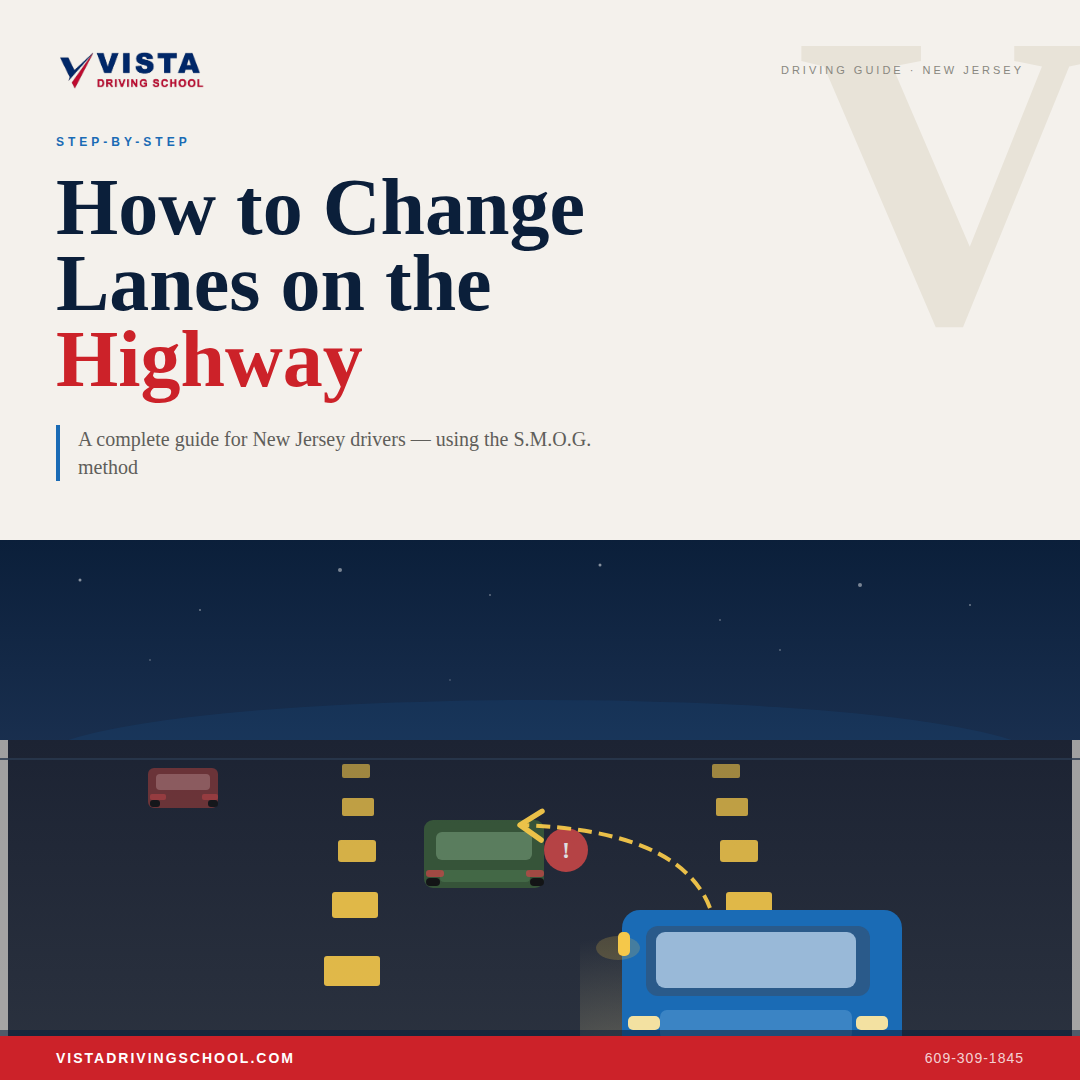
How to Change Lanes on the Highway: A Step-by-Step Guide for New Jersey Drivers
Learn how to safely change lanes on the highway using the S.M.O.G. method. Step-by-step guide following NJMVC rules — perfect for new drivers and adult learners in New Jersey.
Changing lanes on the highway is one of the first real challenges every new driver faces. It sounds simple. But it's also one of the top reasons new drivers — and even experienced ones — get into accidents.
The good news? There's a system. Learn the system, and lane changes go from scary to second nature.
In this guide, we'll walk you through exactly how to change lanes safely on the highway — step by step, the way New Jersey MVC expects you to do it.
What New Jersey Law Says About Changing Lanes
Before we talk technique, let's talk rules.
Under New Jersey law, a vehicle must be driven as nearly as practicable entirely within a single lane and must not be moved from that lane until the driver has first confirmed that the movement can be made safely. That's not optional. That's the law.
Here are two more NJ rules every driver needs to know:
The Keep Right Law: New Jersey's left lane law designates the left lane for passing only. Drivers must use the right lane unless they are actively overtaking another vehicle or preparing for a left turn. Staying in the left lane when you're not passing someone can get you a ticket — and points on your license.
The Move Over Law: New Jersey's Move Over law requires all motorists approaching a stationary emergency vehicle, tow truck, or highway maintenance vehicle displaying flashing lights to change lanes into a lane not adjacent to that vehicle — when it is safe to do so. If you can't move over, you must slow down and be ready to stop.
The S.M.O.G. Method: How to Change Lanes the Right Way
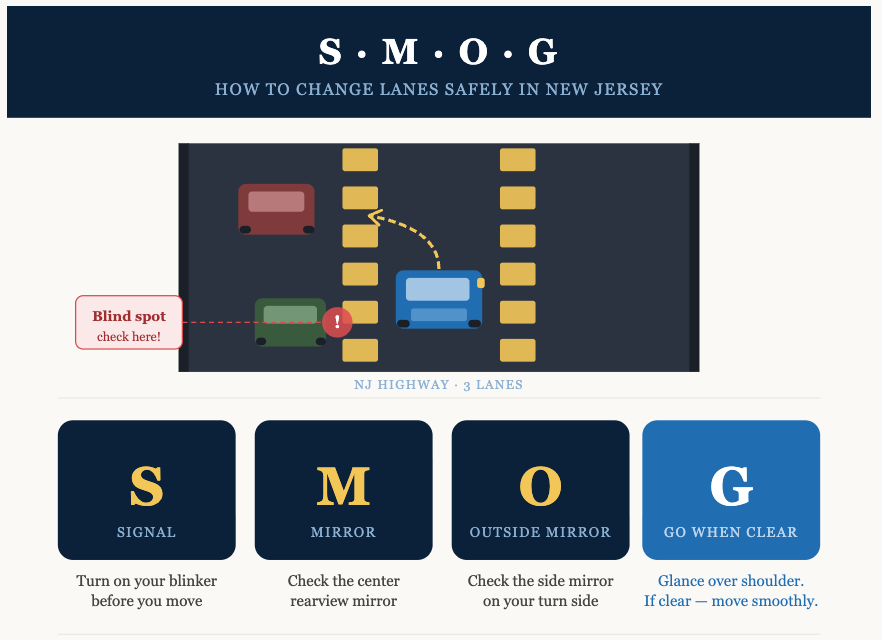
New Jersey driving instructors teach a four-step system called S.M.O.G. It's the same method used during your NJ road test. Master this, and you'll always know exactly what to do.
S.M.O.G. stands for:
S — Signal
M — Mirror (rearview/inside)
O — Outside mirror
G — Glance (blind spot check) — then Go when clear
Let's break each one down.
S — Signal First
Turn on your blinker before you move. Not while you're already moving — before.
Your signal is a message to every driver around you: I am about to change lanes. It gives them time to adjust. In New Jersey, signaling before a lane change is required by law.
💡 Tip for new drivers: Turn your signal on, count to three, then start your checks. This gives drivers behind you time to see it.
M — Check Your Rearview Mirror
Look at the mirror in the center of your windshield. This shows you what's directly behind your car.
Ask: Is there a car close behind me? Is it coming fast?
If yes — wait. Don't move yet.
O — Check Your Outside Mirror
Now look at the side mirror on the same side as your lane change.
Moving right? Check the right mirror.
Moving left? Check the left mirror.
You're looking for cars, motorcycles, and trucks in the lane next to you — especially ones that are close or moving fast.
G — Glance Over Your Shoulder (The Blind Spot)
This is the step most new drivers skip. It is the most dangerous step to skip.
Your mirrors are good — but they don't show everything. On both sides of your car, there is an area your mirrors cannot see. This is called the blind spot. A car can be right there, and you won't see it in your mirrors.
To check it: quickly look over your shoulder in the direction you want to go. Just a fast glance — one to two seconds — then look forward again.
If that space is empty — Go. Smoothly and steadily.
If there's a car there — Wait. Let them pass, then check again.
Full Step-by-Step: How to Change Lanes on the Highway
Here is the complete sequence, start to finish:
Plan ahead. Decide early that you need to change lanes. Don't wait until the last second.
Make sure there's space — in front of you and behind you in the target lane.
Turn on your signal.
Check your rearview mirror (center).
Check your outside mirror (side, same direction as your move).
Glance over your shoulder to check the blind spot.
If everything is clear — move smoothly. Keep your speed steady.
Turn off your signal once you're fully in the new lane.
Most Common Lane Change Mistakes (And How to Avoid Them)
Signaling at the same time you move. Your signal is a warning — not an announcement that you're already going. Signal first, wait, then move.
Only checking one mirror. You need all three checks: rearview, outside mirror, blind spot. Every time. No shortcuts.
Changing two lanes at once. Move one lane at a time. Get into the middle lane, settle, check again, then move to the next lane.
Moving too fast. A lane change should feel like a slow slide — not a jump. Gradual is safer.
Forgetting to check what's in front of you in the new lane. Most people focus so hard on what's behind and beside them that they forget to confirm there's open space ahead in the new lane too.
Highway Driving Tips Specific to New Jersey
New Jersey highways have their own personality. Here's what to keep in mind:
The left lane is for passing only. Pass, then move back right. Don't camp there.
Match the speed of traffic in the lane you're entering before you move over.
Give trucks extra space. Large trucks have much bigger blind spots than regular cars. If you can't see the truck driver in their mirror, they can't see you.
Plan your exits early. On busy NJ highways, exit lanes fill up fast. Don't wait until the last moment to cross multiple lanes.
One lane at a time. Even if you need to move two lanes left, do it one at a time.
Frequently Asked Questions About Changing Lanes in New Jersey
How far in advance should I signal before changing lanes in NJ? New Jersey law requires you to signal before changing lanes. As a general rule, signal at least 100 feet before your move on regular roads, and earlier on the highway where cars are moving faster.
What is a blind spot? A blind spot is an area around your car that your mirrors cannot show you. It sits on both sides of your vehicle, slightly behind the rear door. The only way to check it is to quickly look over your shoulder.
Can I change two lanes at once in New Jersey? You should always move one lane at a time. Moving two lanes at once is considered an unsafe lane change and can result in a ticket — and a serious accident.
What is the S.M.O.G. method? S.M.O.G. stands for Signal, Mirror, Outside mirror, Glance (blind spot check) — then Go when clear. It's the standard lane change method taught by NJ driving instructors and tested on the NJ road test.
What happens if I fail to signal before changing lanes in NJ? Failing to signal is a moving violation in New Jersey. It can result in a fine and points added to your license.
The Bottom Line
S.M.O.G. takes about three seconds. Those three seconds are the difference between a smooth lane change and a crash.
Signal. Mirror. Outside mirror. Glance. Go.
Do it every time. Make it automatic. That's what safe driving looks like.
Want to build your highway confidence with a patient, professional instructor? Vista Driving School serves new drivers, adult learners, and international license holders across Mercer, Hunterdon, and Burlington counties in New Jersey.
📞 Call or text: 609-309-1845
🌐 Book online